What made the Roman Empire abandon one of its distant yet valuable provinces in AD 410? Why did a region that had been under Roman rule for almost four centuries suddenly find itself cut off from imperial support? And how did this transition reshape the future of Britain?
These questions have intrigued historians for generations. While older interpretations imagined a dramatic exodus of Roman soldiers departing by ship while native Britons wept on the shores, modern research reveals a far more gradual, complex, and multifaceted process.
The Roman withdrawal was not a single decision or event but the outcome of political instability, economic strain, military overreach, and cultural shifts both within Britain and across the Roman Empire.
Why Did the Romans Conquer Britain in the First Place?
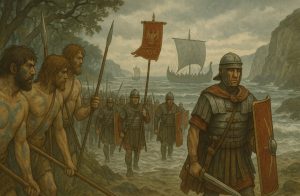
The Roman conquest of Britain began in AD 43 under Emperor Claudius. Britain, known for its rich natural resources, especially tin, lead, silver, and fertile agricultural land, was an appealing prize.
But the conquest also had symbolic value. Claudius, a relatively new and untested emperor, sought to prove his legitimacy through military success.
Roman accounts portrayed the Britons as barbaric, ruled by druids who practised human sacrifice and resisted civilisation. For Rome, conquering Britain was a mission of economic, military, and ideological importance.
By the 80s AD, Rome had established firm control over much of what is now England and Wales. The construction of roads, forts, and towns helped integrate the territory into the broader empire.
Cities such as Londinium (London), Camulodunum (Colchester), and Aquae Sulis (Bath) reflected classical Roman urban planning with forums, bathhouses, amphitheatres, and administrative centres.
Over time, the province of Britannia developed into a significant contributor to the empire’s economy. Its exports included grain, wool, leather, hunting dogs, and precious metals, all transported via Roman-built infrastructure.
How Did Roman Rule Shape Life in Britain?
Roman rule deeply influenced urban development, architecture, and governance. Cities emerged as key administrative and commercial hubs, where Roman law and customs were imposed, and tax collection was centralised.
Wealthy Romans and Romanised Britons lived in villas with underfloor heating and mosaic floors, particularly in the south-east.
In regions such as Kent and the Midlands, Romanisation was more successful. Towns like Chester had amphitheatres for blood sports and civic life, while Lullingstone Villa in Kent revealed luxury and, eventually, early Christianity.
However, this Roman cultural influence did not spread equally across the island. The far north and west remained largely rural and less integrated into the Roman system.
The Scottish Highlands and parts of Wales resisted Roman control, leading to the construction of defensive structures like Hadrian’s Wall in AD 122.
When Did Roman Control Begin to Weaken?
By the third century, the Roman Empire was beginning to fray at the edges. This period, known as the Third-Century Crisis, brought civil wars, foreign invasions, assassinations, and rapid changes in emperors.
Britain was not immune to the effects. Troops were frequently recalled to the continent to support imperial campaigns. Many did not return, and local garrisons were left to defend vast areas with minimal support.
At the same time, trade routes became unreliable, and essential goods from the Mediterranean became scarce.
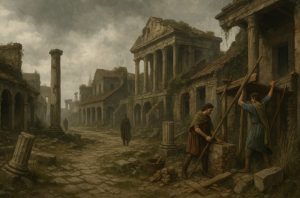
Britain’s cities and infrastructure began to suffer. Monumental civic buildings fell into disrepair, and skilled labour became harder to find.
In cities like Wroxeter, once-grand forums were gradually replaced with timber structures built within the ruins, as local communities tried to maintain basic services.
How Did Economic Pressures Influence the Decision to Withdraw?
The cost of maintaining distant provinces like Britain was rising steadily, while the benefits were diminishing. Continuous warfare internally and at the borders drained the empire’s coffers.
Rome’s dependence on slave labour, declining productivity, and the debasement of its currency all led to inflation and economic collapse.
To finance military campaigns, emperors reduced the silver content of coins, leading to rampant inflation and a collapse in monetary confidence. Trade suffered, tax revenues plummeted, and local economies faltered.
In Britain, the once-vibrant urban economy began to collapse. With Rome unable to supply goods or maintain roads and cities, Britain was forced to become more self-reliant.
Villas like Lullingstone remained prosperous into the fourth century, but even these rural estates eventually declined as imperial support vanished.
What Military Challenges Led to the Roman Exit?
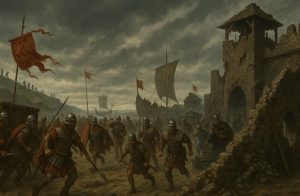
The Roman military faced pressure on multiple fronts. On the continent, Germanic tribes like the Vandals, Goths, and Huns pushed against Roman borders.
In AD 410, the Visigoths, led by Alaric, famously sacked the city of Rome an event that shocked the ancient world and underscored the vulnerability of the empire.
In Britain, the situation was no less volatile. Picts from the north, Irish raiders from the west, and Germanic tribes from across the North Sea all posed constant threats.
The Roman military was stretched too thin to defend Britain while also protecting more critical parts of the empire like Gaul and Italy.
Rome began to adopt a new military strategy known as the Strategy of the Limes. This focused on consolidating defences around the empire’s heartlands, with troops stationed only at key points. Britain, on the outer edge of the empire and costly to defend, no longer fit this model.
What Was the Honorius Rescript and Why Is It So Important?
In AD 410, the Roman Emperor Honorius reportedly sent a rescript to the cities of Britain, instructing them to look to their own defence. The message was prompted by a plea from British authorities, who were desperate for military aid.
This rescript did not formally sever Britain from the empire, but it made Rome’s position clear: no help was coming. With the capital city of Rome itself under threat, the defence of a distant province like Britain was no longer possible.
This moment is generally considered the official end of Roman Britain, though the withdrawal had been underway for years.
What Did Life in Post-Roman Britain Look Like?
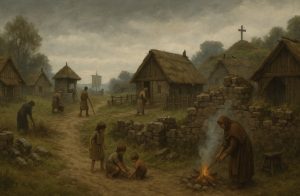
The aftermath of Rome’s departure was marked by fragmentation, decline, and adaptation. Without imperial oversight, Britain became a land of scattered communities, local warlords, and subsistence living.
Coinage stopped circulating. Long-distance trade declined sharply. People relied on bartering, subsistence farming, and local resources. Urban living gave way to rural survivalism. Grand villas and towns were abandoned or repurposed.
Christianity, however, began to fill the void left by the Roman administrative system. Churches emerged in places like Wroxeter and Lullingstone.
The church retained a sense of organisation and community, offering some continuity from Roman civilisation into the early medieval period.
Did Roman Culture Vanish Completely After the Withdrawal?
Not entirely. While physical infrastructure decayed, aspects of Roman culture lingered. The Latin language continued to influence local dialects. Roman law and administrative ideas persisted in the practices of the early church.
In the western regions of Britain, especially in places like Tintagel in Cornwall, there is archaeological evidence of trade with the Eastern Roman Empire (Byzantium) continuing well into the sixth century.
High-status pottery, glassware, and wine were imported through Atlantic routes, bypassing the disrupted connections with Gaul.
This continuity demonstrates that Britain, though politically cut off from Rome, remained culturally and economically connected in some areas.
What Legacy Did the Romans Leave Behind in Britain?

The Roman presence left a profound imprint on Britain. Although few Roman buildings remain intact, their influence survives in road layouts, place names, and historical memory.
Roman ideas were revived centuries later during the Renaissance, Enlightenment, and Victorian era—times when Britain looked back to Rome as a symbol of order, empire, and civilisation.
The early church also carried forward elements of Roman administration, helping bridge the transition between antiquity and medieval Britain.
Today, visiting sites like Hadrian’s Wall, Wroxeter Roman City, and Lullingstone Roman Villa offers valuable insights into the Roman era and its lasting impact on British identity.
Timeline of Roman Britain and Its Withdrawal
| Year | Event |
| AD 43 | Claudius begins conquest of Britain |
| AD 60–61 | Boudicca leads major revolt |
| AD 122 | Construction of Hadrian’s Wall |
| AD 260–274 | Third-Century Crisis weakens Rome’s control |
| AD 367 | The ‘Great Conspiracy’ strikes Roman Britain |
| AD 383 | Withdrawal of troops by Magnus Maximus |
| AD 410 | Honorius Rescript issued—end of Roman support |
Frequently Asked Questions
Was the Roman departure a planned retreat or a forced decision?
It was a strategic decision forced by wider issues across the empire. Rome could no longer defend distant provinces like Britain.
Did Roman towns continue after 410 AD?
Many towns declined rapidly, but some adapted. Timber buildings replaced stone structures, and marketplaces survived in altered forms.
Were there attempts to reconnect with Rome after the withdrawal?
Local leaders hoped for renewed support, but no military aid returned. Britain was left to govern itself.
What role did Christianity play after Rome left?
The church became a key unifying institution, inheriting many administrative functions and continuing Roman cultural traditions.
Did trade completely collapse after Roman withdrawal?
Not entirely. While trade with Rome ceased, connections with the Eastern Roman Empire continued in some western regions.
Why was Britain no longer important to Rome?
The cost of defending Britain outweighed its economic value. Rome prioritised core regions like Italy and Gaul.
How can we see evidence of Roman Britain today?
Sites like Hadrian’s Wall, Richborough Fort, and Lullingstone Villa offer direct insight into the Roman legacy in Britain.
ALSO READ: