If birds had a Tripadvisor, power lines would probably get five stars: great views, nice and warm, rarely interrupted. Ever looked up and noticed rows of birds just chilling on those thin cables, completely unbothered by the humming electricity beneath their feet? It seems like such an odd choice of perch, you’d think they’d prefer a leafy tree branch or a cosy rooftop. So, what’s really going on here?
Let’s unravel the mystery behind why birds seem to have such a peculiar fondness for sitting on power lines.
What Makes Power Lines So Appealing to Birds?
It’s easy to assume birds perch on wires because there’s nowhere else to sit, but that’s not entirely true. Power lines offer birds a mix of convenience, comfort, and safety that’s hard to beat.
First off, they’re elevated, which is a win when you’re a small creature trying to avoid predators. From that height, birds can spot food, danger, or rivals with ease.
And yes, while they don’t exactly scream “comfy,” wires provide something a tree can’t consistently. Trees move, sway, and come with a host of other tenants like insects or other birds. Wires, on the other hand, are sturdy, smooth, and evenly spaced. Birds like a bit of personal space too, you know.
In open spaces or urban areas where natural perches are limited, power lines become a convenient alternative. They’re everywhere, they’re high up, and they offer a great vantage point. What more could a bird ask for?
Do Birds Really Not Get Electrocuted?
Now this is the question everyone thinks but rarely asks out loud. And it’s a fair one, you wouldn’t catch a human casually sitting on a live wire. So how do birds get away with it?
It all comes down to basic physics. Electricity needs a path to flow, and it always seeks the quickest route to the ground. When a bird perches on a single power line, both its feet are on the same wire. That means there’s no voltage difference between its left foot and its right foot. In the world of electricity, no voltage difference means no flow of current and no shocking surprise.
The danger kicks in when a bird touches two wires at once, or a wire and a grounded object (like a metal pole). That creates a circuit, and unfortunately for the bird, its body becomes the conductor. But in most cases, birds are smart (or instinctive) enough to avoid those situations.
So no, they’re not superpowered. They’re just lucky that their tiny toes and good habits keep them safe.
Is There More Than Safety at Play — Like Warmth?
Absolutely. Birds aren’t just hanging out up there for the view or to escape your cat. Some power lines emit a low level of heat, especially during colder months, and birds are all about energy conservation. Think of it like a heated bench on a crisp winter’s day. If you had the choice, you’d probably sit on the warm spot too.
This phenomenon, known as avian thermoregulation, helps birds maintain body temperature.
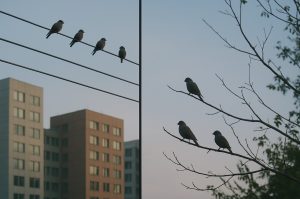
When it’s chilly, perching on a slightly warm cable can make all the difference, especially for small birds with high metabolisms. It’s not exactly a spa treatment, but it’s enough to take the edge off a frosty morning.
How Do Birds Balance So Easily on Such Thin Wires?
Ah, the balancing act — it looks more like a circus trick than a casual rest. Birds make it look effortless, but there’s some impressive biomechanics going on here. Their feet are equipped with a special tendon-locking mechanism. The moment they land and bend their legs, this mechanism engages and tightens their grip around the wire. They don’t even have to try, it’s automatic.
This clever system means birds can perch for hours, even doze off, without toppling over. The shape of their claws also helps to curve and is designed to hug narrow surfaces. Combine that with light body weight and instinctive balance, and you’ve got a creature perfectly adapted to perching on a cable thinner than your pinky.
Why Are Power Lines Popular for Group Hangouts?
Have you ever seen a whole squad of birds lined up like an avian choir, each perfectly spaced? That’s not random. Many birds, particularly species like starlings or sparrows, are social creatures. Power lines offer an ideal setup for group roosting, they’re linear, predictable, and everyone gets a spot.
Perching together helps birds stay warm, especially at dusk. It also allows them to communicate like chirping, calling, or just keeping tabs on each other before flying off en masse. It’s their version of gathering at the pub for a quick catch-up before heading home.
Can Birds Actually Cause Power Outages?
As innocent as they look, birds can occasionally be a bit of a nuisance to power infrastructure. Large birds or flocks can trigger short circuits, especially if they bridge two conductors or come into contact with live components and grounded structures.
Here’s a look at how bird-related incidents can impact electrical systems:
| Incident Type | Description |
| Bridging Conductors | A large bird touches two lines at once |
| Nesting on Equipment | Nests interfere with insulators and cooling systems |
| Droppings on Insulators | Can cause corrosion and reduced performance |
| Bird Collisions | Damage both to the bird and electrical gear |
To combat this, energy companies install devices like bird diverters, insulated covers, and perch guards to make power lines safer for both birds and people.
Do Birds Prefer Power Lines Over Natural Perches?
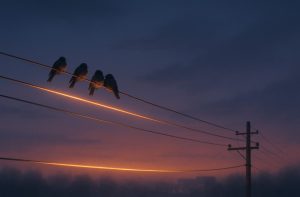
It depends on what’s available, really. In rural or forested areas, trees are still the top choice. But in cities, towns, or farmland, power lines are often the most accessible perch. Birds are adaptable. They’ve been evolving for millions of years, a few cables and pylons won’t faze them.
Interestingly, birds tend to favour certain types of lines. Medium-height cables are often preferred, high enough to be safe, but not too high to be cold or exposed. Wires that are thicker or have good grip are also more likely to host a feathered visitor.
Which Birds Are Most Likely to Perch on Power Lines?
Not all birds are equally fond of the wire life. Smaller, lightweight birds are more likely to be seen on power lines, particularly those comfortable in urban or semi-urban areas.
Here’s a quick glance at the usual suspects:
| Bird Species | Likelihood of Perching | Notes |
| Starlings | Very High | Often gather in large, noisy groups |
| Pigeons | High | Common in cities, use lines to scout areas |
| Sparrows | High | Small size makes perching easy |
| Crows | Moderate | Heavier, prefer wider perches |
| Hawks/Falcons | Low to Moderate | Only perch on very high-tension wires |
You won’t see owls or robins up there as often; they prefer trees or more concealed spaces.
So, Why Do Birds Sit on Power Lines After All?
In the end, birds aren’t making a conscious decision to be quirky; they’re simply choosing what works best for them. Power lines offer safety from predators, a clear view, social space, warmth, and wide availability. It’s not about comfort or aesthetics, it’s about survival, efficiency, and instinct.
And thanks to their unique anatomy and the laws of physics, they manage to do it all without getting fried. Clever little things, aren’t they?
Frequently Asked Questions
Do birds ever get electrocuted on power lines?
Yes, but only under specific circumstances like touching two wires at different voltages or a wire and a grounded object. This creates a circuit that allows electricity to pass through their body.
Why don’t birds get shocked like humans?
Because they typically sit on one wire at a time, there’s no voltage difference across their body. Humans, on the other hand, often provide a path to the ground when touching a wire.
Are power lines warm enough to attract birds?
They can be, especially in cold weather. Birds often seek out slightly warmer spots to conserve energy and power lines offer just enough heat to help.
Can birds sleep while perched on wires?
Yes, birds can sleep on power lines. Their tendon-locking mechanism allows them to grip the wire securely even while resting.
Do birds ever fall off wires?
Rarely. Their natural balance and foot structure make them excellent perchers, even in windy conditions.
Do certain types of birds avoid power lines?
Some ground-dwelling or canopy-dwelling birds may avoid power lines, but urban species have adapted well and use them regularly.
What do energy companies do to protect birds?
They install insulation covers, diverters, and other equipment to prevent electrocutions and nesting-related issues, promoting safer interaction between wildlife and infrastructure.