
Is the UK government finally doing enough to support pensioners amid rising living costs? What exactly is the £2,300 pension bonus, and why now?
These are questions many retirees and financial commentators are asking following the government’s recent announcement of a £2,300 one-off pension bonus. Set to be rolled out in 2025, this payment is part of a broader strategy to offer targeted financial relief for vulnerable pensioners struggling with increasing healthcare costs, housing pressures, and inflation.
Unlike the regular State Pension triple lock increase, which will also take effect in 2025, this lump-sum bonus is not intended for all retirees. Instead, it is aimed at individuals who are either early claimants of the State Pension or are receiving specific disability-related or cost-of-living benefits.
The bonus is a response to public concern that the current State Pension, even with annual rises, may not be enough to cover essential living costs for all pensioners, particularly those with high personal or medical expenses.
What Is Changing with the State Pension in 2025?
In addition to the £2,300 bonus, the government has confirmed a 4.1% increase in the State Pension as part of its triple lock commitment. This mechanism guarantees that pensions rise each year by the highest of three measures: inflation, average wage growth, or 2.5%.
For 2025, the rise is driven by inflation, leading to the following adjustments:
| Pension Type | 2024 Weekly Rate | 2025 Weekly Rate | 2025 Annual Total |
| Full New State Pension | £221.20 | £230.30 | £12,016.75 |
| Basic State Pension | £176.45 | Estimated ~£176.45 | ~£9,200 |
This increase applies to everyone who qualifies under the standard pension rules. However, the £2,300 bonus is additional and designed to provide extra support to those facing exceptional financial circumstances.
Who Is Eligible for the £2,300 One-Off Pension Bonus?

Eligibility for this new payment is not universal. The government has made it clear that the £2,300 bonus will be automatically paid only to those who meet certain criteria related to financial need or early pension claims.
Those who started claiming the State Pension before reaching the standard retirement age of 66, as well as individuals currently receiving benefits like Pension Credit or Attendance Allowance, are among the main recipients. The government has stated that no application is necessary for those who qualify.
To provide clarity, the eligibility criteria are outlined in the table below:
| Eligibility Group | Qualification Requirement |
| Early Pension Claimants | Must have started claiming State Pension before age 66 |
| Medical or Disability Expenses | Must be receiving support for long-term health or care costs |
| Qualifying Benefits | Must receive benefits like Pension Credit or Attendance Allowance |
| Residency and Timing | Must be living in the UK and receiving these supports in early 2025 |
| Pension Deferral | Those who have deferred their pension may not be eligible |
This targeted approach, while welcome by some, has led to renewed debate around the complexity of pension rules and the fragmentation of elderly support systems.
When and How Will the Bonus Be Paid to Eligible Pensioners?
The Department for Work and Pensions (DWP) has confirmed that the £2,300 pension bonus will be disbursed between April and June 2025. Payments will be made directly into the recipient’s existing pension or benefit account, appearing as “DWP BONUS” on the bank statement.
The government advises that no action is needed for those who qualify, although pensioners are urged to keep their personal and bank details updated with DWP to avoid delays.
While there is no confirmed fixed date, there are indications that some payments could arrive earlier, particularly around the Easter period (April 17, 2025). If a qualified individual has not received the payment by the end of June 2025, they are encouraged to contact the DWP directly.
What Other Pension Changes Are Coming in 2025?
Aside from the bonus and the regular triple lock increase, several other pension-related changes are on the horizon.
In Scotland, the Pension Age Disability Payment will begin replacing Attendance Allowance starting from April 2025. This change aligns with Scotland’s broader social security reforms and is expected to provide more tailored support to older individuals requiring long-term care.
The broader context of 2025’s pension updates reflects increasing concern over the growing cost of retirement in the UK.
Financial analysts and advocacy groups have argued that even with these enhancements, the current pension model still leaves gaps, particularly for carers, women with interrupted work histories, and low-income earners.
What Is the Proposed £28,500 Universal Pension and Why Is It Being Debated?
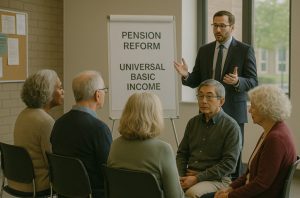
One of the most talked-about proposals in recent months is the introduction of a £28,500 universal pension for all UK residents aged 60 and over, regardless of employment history or contributions.
Supporters of the plan argue that the existing pension model is too complex, outdated, and unfairly penalises those who have not been in full-time work due to caregiving responsibilities or long-term illness.
The proposal suggests that every eligible citizen would receive a flat, non-means-tested pension, effectively providing a stable and livable retirement income.
To put the differences in context, the table below compares the current pension framework with the universal proposal:
| Feature | Current Pension (2025) | Proposed Universal Pension |
| Eligibility Age | 66 (rising to 67 by 2028) | 60 |
| Weekly Payment | ~£230.30 | ~£549.12 |
| Annual Payment | ~£12,016.75 | £28,500 |
| Based on NI Contributions | Yes (10–35 years required) | No (universal access) |
| Means-Tested Top-Ups | Yes (e.g., Pension Credit) | No |
Although the plan has not been adopted by the government, it has gained significant public backing. Petitions supporting the proposal have gathered tens of thousands of signatures, and campaigners argue that it would eliminate pension poverty, simplify the system, and give pensioners financial dignity.
Why Is the DWP Facing Pressure to Reform the Pension System?
The DWP is under increasing scrutiny for what many see as a patchwork of short-term solutions. While measures like the £2,300 bonus are helpful in the short run, many believe they fail to address long-term issues around inequality and retirement security.
Rising costs of living, particularly in food, energy, and housing, have outpaced pension growth. Additionally, women, carers, and part-time workers continue to be disproportionately affected due to gaps in their National Insurance records.
The planned increase in retirement age to 67 by 2028 has also raised concerns among manual labourers and others who may find it difficult to remain in the workforce into their late 60s.
Calls for a simplified, universal pension model are seen as a response to these pressures, with campaigners urging the government to take more decisive action.
At present, the DWP maintains that the triple lock system provides a fair and balanced approach, supported by other benefits like free prescriptions, winter fuel payments, and Pension Credit. However, critics argue that these fragmented supports lack the impact and simplicity of a universal model.
How Can Pensioners Prepare for the £2,300 Bonus and Other Changes?

To avoid missing out on upcoming payments and changes, pensioners are encouraged to take a few essential steps.
First, it is vital to check eligibility for the bonus, particularly if you are receiving support like Pension Credit or Attendance Allowance. If you’re uncertain, speaking with Citizens Advice or accessing the State Pension Forecast tool on GOV.UK can provide clarity.
Second, make sure your bank details and personal contact information are current with the DWP. Incorrect or outdated information can result in payment delays or missed entitlements.
Lastly, keep track of official announcements through trusted sources. Many pensioners remain unaware of payments they may qualify for, such as the DWP’s £1,100 tax-free support schemes or region-specific benefits.
Who Will Benefit the Most from These Pension Developments?
The changes being introduced in 2025, especially the £2,300 bonus will benefit pensioners who face the highest levels of financial insecurity. Among those expected to gain the most are:
- Individuals who began claiming pensions early due to ill health or redundancy
- Carers and women with limited National Insurance records
- Seniors requiring long-term care or medical assistance
- Low-income pensioners relying on additional support like Pension Credit
- Residents in Scotland who will benefit from more tailored disability payments
However, the broader question remains: will these targeted changes be enough to support the ageing population long-term, or is a more fundamental reform, such as the universal pension, necessary?
Frequently Asked Questions About the 2025 Pension Bonus and Reforms
Is the £2,300 bonus a recurring payment?
No, it is a one-off payment provided in 2025 for eligible pensioners facing specific financial or medical needs.
Will the bonus affect my tax or other benefits?
No. The £2,300 bonus is tax-free and will not affect other benefits, including Pension Credit or housing support.
How do I know if I qualify for the bonus?
You may qualify if you are receiving the State Pension before age 66 or if you’re currently on benefits like Attendance Allowance or Pension Credit. The payment will be made automatically if you’re eligible.
What is the Pension Age Disability Payment in Scotland?
This is a new benefit replacing Attendance Allowance in Scotland from April 2025, aimed at improving care-related financial support for older people.
Can I still get the bonus if I live abroad?
Generally, UK residents qualify. Those living abroad may not be eligible unless they are receiving qualifying UK benefits and meet residency conditions.
What happens if I defer my pension?
If you’ve deferred your State Pension, you may not be eligible for the £2,300 bonus, as the payment is linked to current pension receipt during early 2025.
Is the £28,500 universal pension going ahead?
Not yet. It’s a proposed reform gaining public support, but the DWP has not committed to implementing it at this time.