
Have you ever been stuck behind a car with a glaring red light on a clear night and found yourself struggling to see properly? Chances are, the vehicle in front had its rear fog lights left on and unnecessarily so. While these lights are extremely useful in the right conditions, using them at the wrong time can do more harm than good.
In the UK, fog is a fairly common challenge, especially during the autumn and winter months. This has made rear fog lights an essential safety feature. But with great power comes great responsibility, and the misuse of rear fog lights can lead to confusion, distraction, and even accidents.
In this article, we explore why it’s dangerous to leave rear fog lights on when they are no longer needed, how they can impact other road users, and what the law says about it.
What Are Rear Fog Lights and Why Are They So Bright?
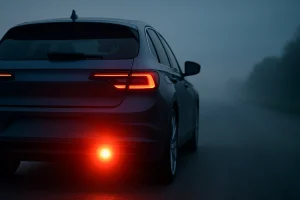
Rear fog lights are designed to make your vehicle more visible in conditions where visibility is severely reduced. These are not your standard tail lights, they’re significantly brighter, similar in intensity to brake lights, but designed to be continuously on rather than activated by braking.
The brightness is necessary when you’re driving in dense fog or heavy snow, where normal lights might not be visible from a safe distance. In those situations, they can make the difference between being seen or being rear ended.
However, because they’re so bright, using them outside of those specific conditions can quickly become a hazard.
How Can Rear Fog Lights Cause Confusion on the Road?
One of the major concerns with rear fog lights is how easily they can be mistaken for brake lights. Since both are red and appear in the same area of a vehicle’s rear, drivers following behind can struggle to tell whether the car ahead is actually slowing down or simply has its fog lights on.
This split-second confusion can lead to hesitation or overreaction, particularly in fast-moving or heavy traffic.
A driver on a clear motorway, for example, may spot the bright red rear fog lights on the vehicle in front and assume they’re braking. As a result, they may slow down unnecessarily, which could cause traffic flow issues or, worse, a rear-end collision if the driver behind is not paying attention.
This misinterpretation is even more dangerous at night, where high-intensity lights stand out more aggressively. In such cases, rear fog lights do not add any safety value, in fact, they create an unnecessary visual distraction.
Can Rear Fog Lights Obscure Your Brake Lights?
Another key safety issue is that rear fog lights can actually mask or overpower your brake lights. Because both lights are red, the human eye can struggle to differentiate between them when they’re in close proximity and similar brightness.
If you’re driving with your rear fog lights on in clear weather, your brake lights might blend in and become less noticeable. This becomes a serious problem if you have to stop suddenly.
The driver behind you may not recognise that you’re braking until it’s too late, especially if their visibility is already compromised by glare.
This phenomenon is particularly dangerous in stop-start traffic, where reaction time is essential, or on faster roads where stopping distances are longer. The risk of being rear-ended increases substantially when your brake lights aren’t immediately visible.
Do Rear Fog Lights Dazzle Other Drivers?
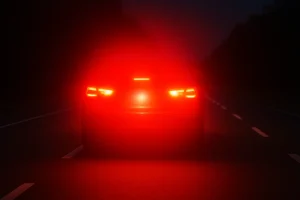
Yes, and this is one of the most common complaints among UK drivers. Rear fog lights are extremely bright, intentionally so, and they’re designed to be seen through dense weather conditions. However, when the weather is clear, their intensity can be blinding for the driver behind you.
Glare from rear fog lights can make it more difficult for other road users to concentrate, affect their depth perception, and cause unnecessary strain on their eyes, particularly during night-time driving or when driving on unlit rural roads. In such conditions, a dazzling light ahead can seriously affect visibility.
Even in daylight, the intense red glow of a rear fog light can become a source of irritation and distraction, especially when stuck in traffic.
The driver behind may be forced to adjust their seating position, use their sun visor, or even drop back, creating inconsistent driving patterns that can affect traffic flow and increase the chances of minor collisions.
When Should Rear Fog Lights Actually Be Used?
Rear fog lights should only be used when visibility drops below 100 metres, roughly the length of a football pitch. This might occur in dense fog, extremely heavy snow, or other weather conditions that significantly reduce visibility on the road.
In contrast, they should not be used during:
- Light rain or drizzle
- Mist that doesn’t affect visibility
- Clear nights or urban street-lit roads
- Motorway driving with normal visibility
- Stop-start traffic with normal weather conditions
The problem is that many drivers assume any sign of mist or dim weather justifies fog light usage. In reality, using them outside of proper conditions is not only unnecessary but also dangerous.
Rear fog lights are not meant to serve as replacements for brake lights or tail lights, and using them for general visibility is a misuse of their function.
What Are the Legal Consequences of Using Rear Fog Lights Incorrectly?
In the UK, the Highway Code provides clear guidance on fog light use. It states that fog lights must only be used when visibility is seriously reduced and that they should be switched off once visibility improves.
Failing to follow this rule can be classified as careless or inconsiderate driving, and drivers can face a Fixed Penalty Notice, which often carries a fine of £50. If the misuse of fog lights leads to a serious incident, it could even result in prosecution under more severe driving offences.
Many drivers are unaware of this rule or assume that there are no penalties for leaving their fog lights on. However, enforcement officers can and do issue fines, especially when the misuse creates a clear hazard to others on the road.
Could Misused Rear Fog Lights Contribute to Accidents?
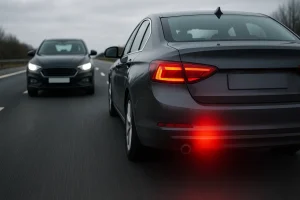
Absolutely. The dangers aren’t theoretical; they can and do result in real-world collisions. Imagine a situation where a driver is travelling at speed on a dual carriageway.
The vehicle in front has rear fog lights on, despite visibility being perfectly fine. A sudden stop causes the trailing driver to brake late because they couldn’t distinguish the brake lights in time, resulting in a collision.
Such situations are not uncommon and highlight how a small oversight like forgetting to switch off your fog lights can have serious consequences. The problem is amplified in poor lighting conditions, during evening commutes, or when drivers are already under visual strain.
How Can Drivers Use Rear Fog Lights More Responsibly?
The first step is awareness. Drivers need to understand the purpose of fog lights and recognise when conditions genuinely warrant their use. Checking visibility should be second nature, if you can clearly see the tail lights of the vehicle in front, chances are your fog lights aren’t needed.
Modern cars often have dashboard warning lights to indicate when rear fog lights are on. Make a habit of checking for that symbol, especially after driving through fog or snow. If your vehicle doesn’t have an automatic deactivation system, it’s your responsibility to manually switch them off.
Familiarising yourself with your vehicle’s lighting controls is also essential. Many drivers simply forget where the fog light switch is or assume it will turn off on its own, and that’s a dangerous assumption to make.
When Should You Turn Off Rear Fog Lights?
Rear fog lights should be turned off as soon as visibility improves. If you can see more than 100 metres ahead, or the fog has started to lift, there’s no reason to keep them on. Continuing to use them not only risks dazzling others, but could also result in a fine or prosecution if seen by law enforcement.
This is especially important when transitioning from rural foggy roads to clearer city routes. Many drivers switch on their fog lights early in their journey and forget to turn them off when weather conditions change. A quick check of your dashboard before entering more populated or well-lit areas can prevent issues.
Table: When to Use and Not Use Rear Fog Lights?
| Driving Condition | Use Rear Fog Lights? | Reason |
| Dense fog (visibility <100m) | Yes | Improves visibility to other drivers |
| Light mist or drizzle | No | Visibility is adequate, fog lights may dazzle others |
| Heavy rain | No | Not intended for rain; causes glare and confusion |
| Clear night on rural road | No | Fog lights create unnecessary glare in dark conditions |
| Stop-start traffic in clear weather | No | May confuse drivers and obscure brake signals |
| Snowstorm with low visibility | Yes | Rear fog lights help others maintain distance and awareness |
Conclusion: Why Fog Light Responsibility Matters?
Rear fog lights are a critical safety feature, when used appropriately. They help other drivers spot your vehicle during periods of reduced visibility and play a valuable role in preventing collisions. However, when used unnecessarily, they become a risk instead of a safeguard.
Misusing them can dazzle and confuse other road users, obscure your brake lights, and lead to avoidable accidents. It’s not just about following the law, it’s about creating a safer environment for everyone on the road.
Make it a habit to assess conditions properly, use your fog lights only when needed, and switch them off promptly when visibility returns. A small action can make a big difference.
FAQs – Rear Fog Light Usage in the UK
Can I be fined for leaving rear fog lights on unnecessarily?
Yes. Misusing fog lights in clear conditions is against the Highway Code and may result in a £50 fine.
Why are fog lights confused with brake lights?
Because both lights are red and bright, fog lights can easily be mistaken for brake lights, particularly at night or in heavy traffic.
Is it ever okay to use fog lights in rain?
No. Fog lights are not intended for rain, even if it’s heavy. Use them only when visibility is severely reduced.
What should I do if I accidentally leave my fog lights on?
Switch them off as soon as you notice. Check your dashboard regularly, especially after driving in poor weather conditions.
How do fog lights affect night-time driving?
In clear night conditions, fog lights create intense glare that can distract and dazzle other drivers, reducing overall road safety.
Are fog lights automatic in modern cars?
Some vehicles come with automatic systems or warnings, but many still require manual activation and deactivation.
Do I need to use fog lights in city traffic during misty mornings?
Usually not. City lighting and traffic flow provide enough visibility, and using fog lights can cause confusion or glare.