Mull of Kintyre has become one of the defining sounds of a Nottingham Forest matchday.
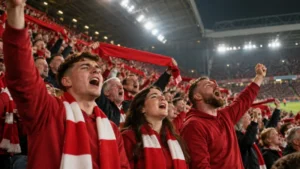
Before kick-off at the City Ground, thousands of supporters join together in an adapted version of the Paul McCartney and Wings song, replacing its Scottish setting with references to Nottingham, the River Trent and Forest’s football history.
The tradition developed in the late 1970s, when the original song’s popularity coincided with Nottingham Forest’s extraordinary rise under Brian Clough and Peter Taylor.
Over time, supporters transformed it from a popular song into something that represented their club, stadium and identity.
That connection remains highly visible in 2026/27.
Forest’s current home shirt uses a tonal pattern inspired by mist rising from the River Trent, while Mull of Kintyre continues to form part of the club’s organised pre-match build-up during Premier League and European fixtures.
| Part of the tradition | Nottingham Forest connection |
| Original song | Released by Wings in 1977 |
| Forest adoption | Developed among supporters in the late 1970s |
| Main geographical reference | River Trent |
| Home setting | City Ground |
| Historic connection | Clough era and European success |
| Modern role | Pre-match supporter ritual |
| European revival | Featured prominently during Forest’s return to Europe |
| 2026/27 connection | Home shirt inspired by mist rising from the Trent |
Why Did Mull of Kintyre Become Nottingham Forest’s Anthem?
Paul McCartney and Wings released Mull of Kintyre in November 1977. The original song expressed attachment to Scotland’s Kintyre peninsula and centred on themes of landscape, home and belonging.
Those ideas translated naturally into football supporter culture.
At almost exactly the same time, Nottingham Forest were entering the most successful period in the club’s history.
The Clough-Era Connection
Brian Clough and assistant Peter Taylor had taken Forest back into the First Division before transforming them into champions.
Forest won the First Division title in 1977/78 before lifting the European Cup in 1979 and 1980.
For supporters living through those seasons, Mull of Kintyre became closely associated with:
- Brian Clough’s Forest
- League success
- European nights
- Travelling support
- The City Ground
- Nottingham football identity
Fans gradually adapted the song around their own experiences rather than simply reproducing the original lyrics.
This kind of supporter-created identity is not unique to Forest. The history behind why Sunderland are called the Black Cats similarly shows how traditions can develop over decades until they become inseparable from a football club.
Why Is the River Trent Central to the Forest Version?
The River Trent is what turns the Forest adaptation into a song specifically about Nottingham.
The City Ground sits beside the river, allowing supporters to replace the Scottish landscape of the original with something immediately visible around their own stadium.
Its best-known adapted line is:
“Oh mist rolling in from the Trent”
That short phrase establishes the song’s location without needing to mention the club by name.
The different references within the Forest version also build a wider football story.
| Reference | Meaning for Forest supporters |
| River Trent | Nottingham and the stadium’s location |
| Mist | Familiar Trentside imagery |
| City Ground | Forest’s historic home |
| Nottingham choir | Collective supporter voice |
| Away grounds | Generations of travelling supporters |
| Clough-era references | Forest’s most successful teams |
| Derby references | Local rivalry |
The anthem therefore works because it combines place, memory and football history in one supporter tradition.
Why Does the 2026/27 Home Kit Strengthen the Anthem’s Connection?
The River Trent imagery has now moved from the terraces onto the team’s shirt.
For 2026/27, Nottingham Forest’s home kit features a subtle tonal design inspired by mist rising from the River Trent.
Forest’s official 2026/27 home shirt retains the traditional Garibaldi-red base while using a patterned design influenced by Nottingham’s riverside setting.
The 2026/27 Kit Details
| Feature | 2026/27 design |
| Main colour | Garibaldi red |
| Design inspiration | Mist rising from the River Trent |
| Pattern | Tonal all-over graphic |
| Collar | V-neck |
| Material | Recycled polyester |
| Shirt technology | Climacool |
| Main cultural connection | Forest’s Trentside identity |
The importance of the design comes from its familiarity.
Forest supporters have sung about mist coming from the Trent for decades. The 2026/27 kit takes the same image and places it within the team’s modern visual identity.
The anthem is therefore no longer connected to the River Trent only through supporter lyrics; the imagery also influences how Forest present themselves on the pitch.
How Is Mull of Kintyre Used on Nottingham Forest Matchdays?
Mull of Kintyre is firmly established within the City Ground’s pre-match routine.
Forest regularly encourage supporters to arrive early, get into their seats and participate in the anthem before kick-off.
For example, the club’s official Arsenal matchday guide encouraged supporters to reach their seats early enough to enjoy the build-up and take part in Mull of Kintyre.
The matchday ritual commonly involves:
- Supporters filling the stands before kick-off.
- The song forming part of the stadium build-up.
- Thousands joining the familiar Forest adaptation.
- Scarves and flags appearing during major fixtures.
- The crowd increasingly becoming the dominant voice.
The atmosphere does not come simply from playing a recording over the PA system.
The recording provides the starting point; the supporters turn it into a Forest anthem.
Why Did Forest’s Return to Europe Give the Song New Meaning?
The club’s return to European football added another chapter to a tradition originally associated with Forest’s greatest European era.
During the 2025/26 season, supporters once again experienced major continental nights at the City Ground after a long absence from European competition.
Ahead of the Europa League meeting with Porto, Forest’s official match preview again encouraged supporters to arrive early and participate in Mull of Kintyre.
That created an unusually strong connection between two different Forest generations.
| Period | Anthem connection |
| Late 1970s | Supporters begin adapting the song |
| 1977/78 | Forest become English champions |
| 1979–80 | Anthem becomes associated with European Cup generation |
| Later decades | Tradition survives changing divisions and teams |
| Premier League return | Song remains part of City Ground matchdays |
| 2025/26 | New generation experiences European football |
| 2026/27 | Trent imagery appears on Forest’s home shirt |
The anthem was therefore no longer just recalling Forest’s European past. It was accompanying a new European chapter.
Why Were Forest’s European-Night Displays So Significant?
European fixtures gave supporters an opportunity to combine the anthem with larger visual displays inside the City Ground.
One major coordinated tifo carried the message:
“For a new generation our time has come.”
The wording captured the central theme of Forest’s European revival.
Supporters who remembered the European Cup-winning years were sharing the stadium with younger fans experiencing continental football at the City Ground for the first time.
Mull of Kintyre connected those groups because both generations could attach their own memories to the same song.
The anthem effectively became a bridge between Forest’s European history and its modern European identity.
Why Do the Adapted Lyrics Tell a Nottingham Forest Story?
Forest supporters did more than change a place name in the original song.
Different versions developed with references to:
- The City Ground
- The River Trent
- Famous away grounds
- Brian Clough’s teams
- Nottingham supporters
- Local rivalry
- Past Forest sides
- Hopes for future generations
References to places such as Anfield, Old Trafford and historic football grounds reflect generations of travelling support, while mentions of Clough-era football connect the anthem directly with Forest’s greatest achievements.
The lyrics therefore function almost like a condensed supporter history.
They move between home, travel, success, rivalry and memory, which helps explain why different generations can find something recognisable in the song.
Why Can the Exact Forest Lyrics Differ Between Supporters?
There is no need to treat one long transcription as the only definitive Forest version.
Football songs normally evolve informally through the stands rather than through an official publishing process.
Changes can develop through:
- Different generations singing different verses.
- Particular lines falling out of regular use.
- Verse order changing.
- Shorter versions being used before matches.
- Supporters remembering historical wording differently.
- New references gradually appearing.
The core identity remains much more consistent than the individual verses.
The most recognisable connection continues to be the City Ground and the mist coming from the Trent.
For that reason, explaining the meaning of the lyrics is more useful than insisting that every supporter sings one identical version.
Why Is the City Ground Essential to Mull of Kintyre?
The song would not have the same meaning without the City Ground.
Forest’s stadium stands beside the geographical feature supporters are singing about, creating a direct relationship between the anthem and its surroundings.
The City Ground gives the song:
- A physical setting beside the Trent.
- A connection with Forest’s greatest historical teams.
- A meeting place for generations of supporters.
- A modern Premier League identity.
- A setting for renewed European nights.
This physical relationship distinguishes Forest’s version from a football song that could easily move with a club to any location.
Stadium identity can become particularly noticeable when grounds change.
The explanation of why Everton’s new stadium is called Hill Dickinson illustrates how naming, location and supporter identity can all become part of a club’s wider story.
For Forest, remaining beside the Trent preserves the geographical reference at the heart of Mull of Kintyre.
Why Does the Anthem Still Matter to Younger Forest Supporters?
The survival of Mull of Kintyre depends on new supporters continuing to adopt it.
A young Forest fan attending the City Ground today does not need personal memories of the 1979 European Cup final to understand the importance of the song.
Their connection may instead come from:
- Hearing it with parents or grandparents.
- Experiencing their first City Ground match.
- Seeing scarves raised before kick-off.
- Watching a major Premier League victory.
- Attending a European night.
- Wearing a Trent-inspired 2026/27 Forest shirt.
This allows the meaning of the anthem to change without losing its historical foundation.
An older supporter may immediately think of Brian Clough and European Cups.
A younger supporter may associate the same song with Forest’s return to the Premier League or modern European football.
Both experiences become part of the same tradition.
Does Another Football Club Sing Mull of Kintyre?
Nottingham Forest are not the only supporters to have adapted the song.
Charlton Athletic fans have also used a version built around their local geography, including a Thames reference rather than the Trent.
This demonstrates why the original melody lends itself to football culture. It is easy for large groups to sing and can be adapted around a club’s location.
Forest’s version, however, is particularly closely linked to the period when the club moved from newly promoted First Division side to English and European champions.
That historical timing helped establish the song permanently at the City Ground.
Has Paul McCartney Acknowledged Nottingham Forest’s Version?
Paul McCartney has previously shown awareness that Forest supporters adopted Mull of Kintyre.
During a 2010 radio interview, he was asked whether he might perform the song at the City Ground if Forest returned to the Premier League.
His response was light-hearted and included a message wishing Nottingham well.
The exchange should be treated as an acknowledgement rather than a formal endorsement of the Forest adaptation.
What it does demonstrate is how widely recognised the connection between Nottingham Forest and Mull of Kintyre had become.
Why Does Mull of Kintyre Still Fit Modern Football Culture?

Football has changed dramatically since Forest supporters first began singing the song.
Training, broadcasting, stadium management, kit technology and performance analysis now look completely different from the late 1970s.
Footballers routinely use the GPS tracking vests sometimes mistaken for sports bras, while habits such as cutting holes in football socks and footballers shaving their legs have become familiar features of the modern professional game.
Yet supporter traditions operate differently.
Their value often comes from remaining recognisable even while everything surrounding them changes.
| Forest then | Forest now |
| First Division | Premier League |
| Late-1970s terrace song | Organised pre-match ritual |
| Clough’s European generation | New European Forest teams |
| Traditional football shirts | Performance-engineered kits |
| Supporter-created Trent imagery | Trent-inspired 2026/27 shirt |
| Primarily local football audience | Global Premier League following |
Mull of Kintyre provides continuity between those two versions of Nottingham Forest.
The players, competitions and technology change, but the supporters can still begin a matchday with the same basic ritual.
Conclusion
Mull of Kintyre remains important because virtually every part of Forest’s version still connects directly with the club.
The River Trent still runs beside the City Ground. Forest still play in Garibaldi red. Supporters still gather before kick-off and sing about the place they consider their football home.
What has changed is the number of memories attached to the anthem.
It began during Forest’s extraordinary rise under Brian Clough, became associated with English and European success, survived decades of changing fortunes and eventually accompanied another generation into Premier League and European football.
The 2026/27 home kit adds one of the clearest modern links. Its River Trent mist-inspired design takes imagery supporters have sung about for decades and places it directly onto the Forest shirt.
That is why Mull of Kintyre continues to define Nottingham Forest.
It connects the club’s place, history and supporters, while leaving every new generation enough space to add its own memories.