
For many years, having wisdom teeth removed was almost treated as a normal part of becoming an adult. Today, dentists take a more selective approach.
Healthy wisdom teeth that are not causing disease or damaging nearby teeth do not automatically need to be extracted.
This does not mean experts now believe wisdom teeth should never be removed. The important distinction is between routine preventive extraction and removing a tooth because there is a genuine dental problem.
In the UK, NICE guidance advises against routinely removing pathology-free impacted wisdom teeth and recommends surgery when there is evidence of disease.
For some people, keeping their wisdom teeth is perfectly reasonable. For others, infection, decay, cysts, gum disease or damage to neighbouring teeth can make extraction the safer choice.
Are Wisdom Teeth Necessary?
Wisdom teeth, also known as third molars, are not essential for living, eating or maintaining normal dental function.
They are simply the final molars to develop, usually appearing during the late teenage years or early adulthood.
Humans once relied more heavily on large molars to process tougher foods.
Modern diets, cooking methods and changes in jaw development mean these extra teeth are less important today.
However, being unnecessary does not mean a healthy wisdom tooth has to be removed.
A fully erupted wisdom tooth can function just like another molar if it is properly positioned, healthy and easy to clean.
Many adults live normally with all four wisdom teeth, while others naturally develop fewer or have none at all.
What Is the Purpose of Wisdom Teeth?
Wisdom teeth are essentially additional chewing teeth.
When they erupt normally and meet the opposing teeth correctly, they may contribute to grinding food in the same way as other molars.
Their practical importance, however, is limited.
Losing one or more wisdom teeth generally does not prevent a person from chewing normally because the first and second molars already perform most of the heavy grinding.
Problems tend to occur when there is not enough room in the jaw for the third molars.
A wisdom tooth may then become partially erupted, grow at an angle or remain beneath the gum or bone.
This is called an impacted wisdom tooth.
Importantly, impaction alone does not always mean the tooth needs to be removed. Its position, health and effect on nearby tissues must also be considered.
Can You Live Normally Without Wisdom Teeth?
Yes. People can eat, speak and maintain a normal bite without wisdom teeth.
The mouth contains enough other teeth to handle normal chewing.
Losing wisdom teeth therefore does not usually create the same functional concern as losing important front teeth or major working molars.
After extraction and healing, most people do not notice any difference in their everyday ability to eat.
Temporary difficulty chewing is common immediately after surgery because the gum and jaw may be sore or swollen.
NHS guidance states that discomfort, swelling and jaw stiffness can continue for several days and sometimes for up to two weeks while the extraction site heals.
Will Removing Wisdom Teeth Cause Any Dental Problems?
Wisdom tooth removal does not normally create long-term dental problems when extraction is clinically appropriate and the area heals properly.
Removing a wisdom tooth generally does not:
- Stop You From Chewing Normally
- Create A Permanent Gap In Your Smile
- Make The Other Teeth Stop Working
- Automatically Weaken Your Jaw
- Require The Missing Tooth To Be Replaced
Unlike losing a first or second molar, an extracted wisdom tooth normally does not need an implant, bridge or denture.
However, extraction is still surgery and complications can occur. This is one reason dentists avoid removing healthy teeth without a clear benefit.
Does Wisdom Tooth Removal Affect Chewing or Bite Function?
In most cases, wisdom tooth removal does not significantly affect chewing ability or the way the upper and lower teeth meet.
The other molars continue to grind food effectively. Once the extraction site has healed, patients can normally return to their usual diet.
The situation can differ if a person’s overall dental condition is unusual or several other molars are already missing.
A dentist therefore considers the whole mouth rather than deciding purely on the presence of a wisdom tooth.
Jaw discomfort during recovery should also not be confused with a permanent change in the bite. Temporary stiffness and soreness are common after extraction.
Jaw-related discomfort can sometimes be difficult to distinguish from pain felt elsewhere around the head and face.
People who regularly experience morning head discomfort may also be interested in the different causes of waking up with a headache every morning rather than assuming every symptom around the jaw is caused by a wisdom tooth.
Can Removing Wisdom Teeth Affect Nearby Teeth or Jaw Health?
Removing a wisdom tooth usually does not damage healthy neighbouring teeth when the procedure is performed correctly, but complications are possible.
A wisdom tooth sits immediately behind the second molar. Its roots may also lie near important nerves, particularly in the lower jaw.
Dentists may therefore use X-rays and other imaging when necessary to assess its position before surgery.
Potential complications can include:
- Dry Socket
- Infection
- Bleeding
- Temporary Swelling
- Jaw Stiffness
- Damage To Nearby Structures
- Temporary Or, Less Commonly, Persistent Nerve Symptoms
NHS guidance notes that nerve injury can cause numbness or tingling around the tongue, lips or chin. In many cases it improves, although symptoms can sometimes persist.
This is why a healthy tooth should not be removed simply because it exists.
Why Do Experts Say Healthy Wisdom Teeth Should Not Be Removed Unnecessarily?
The modern approach is based on balancing the possible future benefit of extraction against the immediate risks of surgery.
Removing a healthy wisdom tooth exposes a person to surgical risks without certainty that the tooth would ever have caused a problem.
NICE has recommended since March 2000 that routine prophylactic removal of pathology-free impacted wisdom teeth should be discontinued within the NHS.
This means the idea is not actually a completely new discovery in 2026. What has become more prominent is the emphasis on individual assessment, monitoring and shared decision-making rather than automatic extraction.
The evidence is also more complicated than saying that keeping every wisdom tooth is better.
A Cochrane review found insufficient high-quality evidence to determine whether all asymptomatic, disease-free impacted wisdom teeth should routinely be removed or retained.
For that reason, dentists consider the individual tooth, its position, the surrounding gums, neighbouring teeth and the patient’s overall circumstances.
What Does NICE Say About Wisdom Tooth Removal in the UK?
NICE guidance states that pathology-free impacted wisdom teeth should not routinely be removed as a preventive measure.
Extraction may be appropriate when there is evidence of a genuine problem, including:
- Unrestorable Tooth Decay
- Dental Abscess
- Cellulitis
- Certain Infections
- Root Resorption
- Damage To Adjacent Teeth
- Cysts Or Tumours
- Certain Tooth Fractures
- A Tooth Interfering With Necessary Jaw Surgery
NICE also makes an important distinction regarding pericoronitis, which is inflammation or infection around a partially erupted wisdom tooth.
A first episode is not normally considered enough reason for surgery unless it is particularly severe. Repeated episodes may provide a stronger reason for extraction.
This is why two people with apparently similar wisdom teeth may receive different recommendations.
Do All Impacted Wisdom Teeth Need to Be Removed?
No. An impacted wisdom tooth does not automatically require extraction.
Some impacted teeth remain disease-free for years without producing symptoms or harming surrounding structures.
Others may cause:
- Repeated Gum Infection
- Decay
- Food Trapping
- Gum Disease
- Damage To The Second Molar
- Cysts
- Persistent Pain Or Swelling
The NHS states that wisdom teeth that are not causing problems will usually be left in place and monitored during routine dental appointments.
Another important point is that having no pain does not necessarily prove a wisdom tooth is healthy.
Decay, gum problems or damage to a neighbouring tooth may occasionally develop without obvious early symptoms.
Clinical examination and appropriate imaging can therefore be important.
When Is It Safe to Keep Your Wisdom Teeth?
A dentist may be comfortable leaving a wisdom tooth in place when it is healthy and poses little apparent risk to nearby structures.
Characteristics generally favouring retention include:
- The Tooth Is Healthy
- There Is No Evidence Of Disease
- The Surrounding Gum Is Healthy
- The Tooth Is Not Damaging Its Neighbour
- It Can Be Kept Clean
- There Are No Recurrent Infections
- There Is No Concerning Cyst Or Other Pathology
A fully erupted wisdom tooth that is correctly positioned can simply become another functioning molar.
Impacted teeth may also sometimes be retained when they are pathology-free, although they should still be assessed according to the individual’s dental circumstances.
What Are the Risks of Keeping Problematic Wisdom Teeth?
Avoiding unnecessary extraction does not mean ignoring a tooth that is creating genuine disease.
Partially erupted wisdom teeth can be particularly difficult to clean because a flap of gum may trap food and bacteria.
Possible complications include:
- Pericoronitis
- Tooth Decay
- Gum Disease
- Dental Abscess
- Damage To The Second Molar
- Root Resorption
- Cyst Formation
The Cochrane review also found very low-certainty evidence suggesting that retaining asymptomatic, disease-free impacted wisdom teeth may be associated with increased long-term periodontal problems around the neighbouring second molar.
The evidence was uncertain, which is another reason decisions should be individual rather than automatic.
Bleeding gums or unexplained blood in the mouth should also not automatically be blamed on wisdom teeth. There are several possible oral and non-dental causes of blood appearing in saliva in the morning.
What Are the Risks of Unnecessary Wisdom Tooth Removal?
Even routine-looking wisdom tooth extraction involves surgery.
Possible complications include:
- Pain And Swelling
- Dry Socket
- Post-Operative Infection
- Bleeding
- Temporary Difficulty Opening The Mouth
- Damage To Nearby Teeth
- Nerve Injury
- Delayed Healing
NICE specifically notes that removal of impacted wisdom teeth carries risks including nerve damage, alveolar osteitis, infection, haemorrhage, pain, swelling and restricted mouth opening.
Avoiding unnecessary surgery removes exposure to these surgical risks.
This does not mean extraction is dangerous in every case. Wisdom tooth removal is common and is often appropriate when the likely benefits clearly outweigh the risks.
When Should Wisdom Teeth Be Removed?
Removal is more likely to be recommended when a wisdom tooth is already causing disease or threatening other structures.
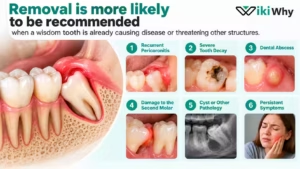
Common reasons include:
Recurrent Pericoronitis
Repeated inflammation or infection around a partially erupted wisdom tooth can cause swelling, pain and difficulty opening the mouth.
Severe Tooth Decay
A badly decayed wisdom tooth may be difficult to restore because of its position at the very back of the mouth.
Dental Abscess
Bacterial infection can produce severe pain, swelling and pus and may require urgent dental treatment.
Damage to the Second Molar
An angled wisdom tooth can sometimes create an area that is difficult to clean and contribute to decay or periodontal problems affecting the neighbouring tooth.
Cyst or Other Pathology
Certain impacted wisdom teeth can develop pathological changes around them. These situations require professional assessment and may make extraction appropriate.
Persistent Symptoms With a Confirmed Dental Cause
Ongoing pain, swelling or other symptoms may justify treatment once a dentist determines that the wisdom tooth is responsible.
Antibiotics are not a substitute for treating the underlying dental cause when definitive dental treatment is required.
Some dental infections may be treated with particular antibiotics in specific circumstances, and anyone prescribed metronidazole should follow the medication advice about why alcohol should not be taken with metronidazole.
Wisdom Teeth Removal vs Monitoring: How Do Dentists Decide?
There is no single rule that applies to every wisdom tooth.
| Situation | Possible Approach |
| Healthy And Fully Erupted Tooth | Usually Keep And Monitor |
| Healthy, Disease-Free Impacted Tooth | Assessment And Monitoring May Be Appropriate |
| First Mild Episode Of Pericoronitis | Immediate Extraction May Not Be Necessary |
| Recurrent Pericoronitis | Extraction May Be Considered |
| Unrestorable Tooth Decay | Extraction Often Considered |
| Dental Abscess Or Serious Infection | Treatment And Possible Extraction |
| Damage To A Neighbouring Tooth | Extraction May Be Recommended |
| Cyst Or Other Pathology | Removal May Be Recommended |
| No Symptoms But Uncertain Condition | Dental Examination And Monitoring |
A dentist will usually consider symptoms, clinical examination, tooth position, gum health and the condition of nearby teeth before recommending treatment.
Patient preferences also matter, particularly where there is no clear evidence that one option is superior.
How Can You Take Care of Wisdom Teeth You Keep?
Keeping a wisdom tooth means keeping the area clean enough to reduce the risk of decay and gum disease.
Useful habits include:
- Brush Twice Daily With Fluoride Toothpaste
- Clean Carefully Around The Back Molars
- Clean Between Teeth Where Possible
- Reduce Frequent Sugary Snacks And Drinks
- Attend Regular Dental Check-Ups
- Report Persistent Pain, Swelling Or Bleeding
Partially erupted wisdom teeth often require extra attention because bacteria and food can collect beneath surrounding gum tissue.
Changes elsewhere in the mouth can also affect oral health.
For example, jewellery and oral habits can introduce their own risks, which is why understanding factors such as why people get tongue piercings can be relevant when considering overall mouth care.
When Should You Seek Dental Help for Wisdom Tooth Problems?
Arrange a dental assessment if you develop persistent:
- Pain Around The Back Of The Mouth
- Swollen Or Red Gums
- Difficulty Opening Your Mouth
- A Bad Taste
- Recurring Infection
- Facial Or Jaw Swelling
- Difficulty Chewing
- Bleeding Around The Tooth
The NHS recommends urgent dental help if bleeding does not stop, pain or swelling is severe or worsening, painkillers are not helping, or pain occurs with a bad taste, high temperature or feeling generally unwell.
Do not assume every symptom around the mouth, ear or head is being caused by a wisdom tooth.
Symptoms such as nausea can also have many unrelated causes, particularly when they persist outside a dental episode, as explained in the overview of why someone may feel nauseous repeatedly.
Conclusion
Wisdom teeth are not essential for normal chewing, speaking or everyday dental function, and removing them usually does not cause lasting problems with the bite or the ability to eat.
However, that does not mean healthy wisdom teeth should automatically be extracted.
The current approach in 2026 is to avoid routine preventive removal of pathology-free wisdom teeth and instead assess each case individually.
Healthy wisdom teeth may remain in place for many years without trouble, while teeth affected by recurrent infection, serious decay, cysts or damage to neighbouring structures may still need removal.
The decision is therefore not simply “keep them” or “remove them.” It is about whether the likely benefit of extraction is greater than the risks of surgery and the risks of leaving the particular tooth in place.
FAQs
Are Wisdom Teeth Important for Adults?
Wisdom teeth are not essential for normal adult dental function. If healthy and properly positioned they can contribute to chewing, but people generally function normally without them.
What Happens If All Wisdom Teeth Are Removed?
After the extraction sites heal, most people can eat and speak normally. Wisdom teeth generally do not need to be replaced with implants, bridges or dentures.
Can Removing Wisdom Teeth Weaken Your Jaw?
Routine wisdom tooth removal does not normally leave the jaw permanently weak.
However, extraction is a surgical procedure and individual risks depend on factors such as tooth position, root anatomy and surrounding bone.
Does Wisdom Tooth Removal Change Your Bite?
Wisdom tooth extraction does not normally cause a significant permanent change in the bite. Temporary jaw stiffness or discomfort may occur while the area heals.
Can You Chew Normally Without Wisdom Teeth?
Yes. The remaining molars provide enough chewing surface for most people to eat normally once healing is complete.
Is It Better to Keep Healthy Wisdom Teeth?
A healthy wisdom tooth does not automatically need removal. UK NICE guidance recommends against routine prophylactic extraction of pathology-free impacted wisdom teeth.
Can Wisdom Teeth Cause Problems Even Without Pain?
Yes. Some dental problems can develop before noticeable pain appears, including decay, gum disease or damage to a neighbouring tooth.
Regular dental assessment helps identify these problems before they become more serious.





2 Comments